news
Stay updated with the latest news and insights from Rafał Kucharski and his research group at Jagiellonian University. Explore updates on transportation systems, machine learning applications, urban mobility solutions, and innovative academic projects shaping the future of mobility.
-
Our group at EWRL 2026
Last week we participated in the European Workshop on Reinforcement Learning (EWRL 2026), presenting two posters showcasing our work on reinforcement learning and multi-agent systems. 🔹 URB – Urban Routing Benchmark for RL-equipped Connected Autonomous Vehicles introduced a comprehensive benchmarking environment for evaluating reinforcement learning methods for urban routing across 29 real-world traffic networks with realistic demand patterns. The benchmark provides standardized tasks, multi-agent reinforcement learning implementations, baseline methods, and domain-specific performance metrics. Experimental results reveal that state-of-the-art methods rarely outperform human routing performance despite substantial training costs, and continue to face significant scalability challenges. 🔹 PC3D: Zero-Shot Cooperation Across Variable Rosters via Personalized Context Distillation introduced a method for enabling decentralized agents to cooperate in teams of varying sizes without execution-time communication or online retraining. By distilling coordination context from a centralized teacher into decentralized policies, PC3D allows agents to infer personalized context from their local interaction histories and adapt their decision-making accordingly. Experiments across three cooperative multi-agent reinforcement learning benchmarks demonstrated higher returns than the evaluated baselines for both seen and unseen team sizes. -
Paris, hEART 2026 and 6 works from our Lab
Paris, hEART2026 - and the Rafal Kucharski Lab is here! 🇫🇷 We are delighted to present 6 works from our group — 3 posters and 3 oral presentations. hEART is always one of those conferences we look forward to - a great place for sharing ideas, discussing new research, and meeting colleagues from across the transportation research community. And while we are enjoying this year’s edition in Paris, we are already looking forward to the next one… 📍 hEART 2027 will be hosted by Jagiellonian University in Kraków! 🇵🇱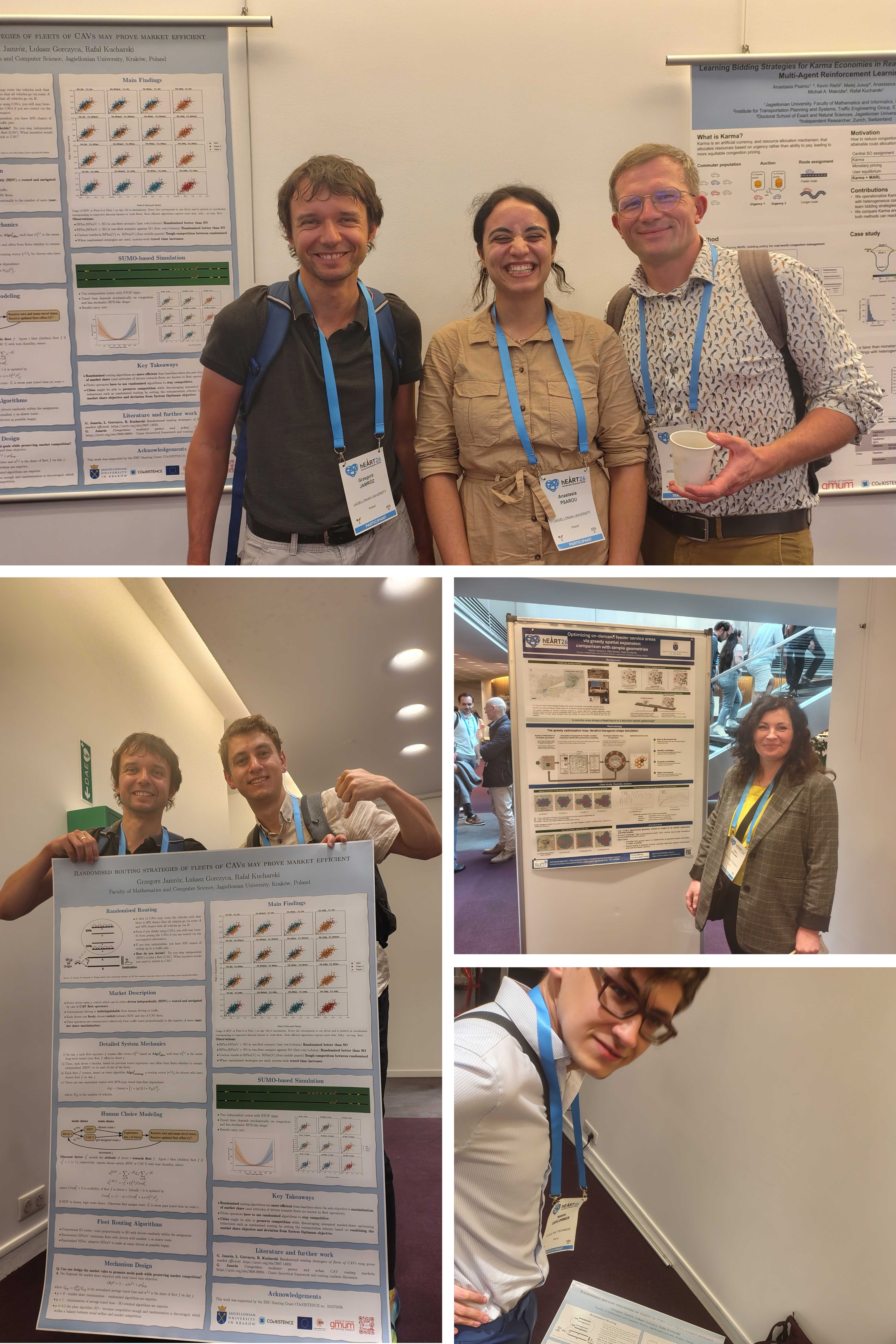
-
What happens when research meets real-world transport challenges? 🚆💡
On 1 September, researchers and transport professionals met in Kraków at the Faculty of Mathematics and Computer Science for Research Meets Practice — a satellite workshop of the EWGT 2026 Annual Conference. As we take a moment to look back on the event, we are pleased to share some highlights from the inspiring discussions and exchange of ideas that took place. The central part of the event organised by Jagiellonian University and Centralny Port Komunikacyjny was the opportunity to exchange experience and engage in the discussion at 3 international roundtables🌍 🔹 Optimisation, Capacity Management and Mathematical Models Experts including Prof. Michael Hewitt (Loyola University Chicago) and Prof. Norman Weik (Technical University of Munich) discussed model calibration and uncertainty, open-source modelling, AI and machine learning, capacity constraints, and ways to prioritise major infrastructure investments. 🔹 Transport Economics, Tariffs and Financial Analysis Participants, including Prof. Alejandro Tirachini (Technische Universität Braunschweig) and Prof. Michał Wolański (SGH Warsaw School of Economics), explored complex fare systems, passenger sensitivity to prices, operator competition, revenue management and the role of early-warning indicators in identifying financial risks. 🔹 Travel Behaviour, Preferences and Passenger Factors With experts including Prof. Achille Fonzone (Edinburgh Napier University), the discussion focused on modern data sources used in analytical tools Passenger Transport Model and Freight Transport Model, developed within Centrum Transportu i Mobilności Port Polska. We looked at the potential of Big Data, including mobile phone mobility data, GPS applications and payment card data, as well as its limitations and the additional information needed to accurately understand real travel patterns. Designing a nationwide multimodal transport network is not a task with ready-made answers. It takes reliable data, robust models, practical experience and continuous exchange between researchers and practitioners. This is where research truly meets practice — and where better transport decisions begin. The meeting was initiated and developed by Rafal Kucharski and Arek Drabicki 🤝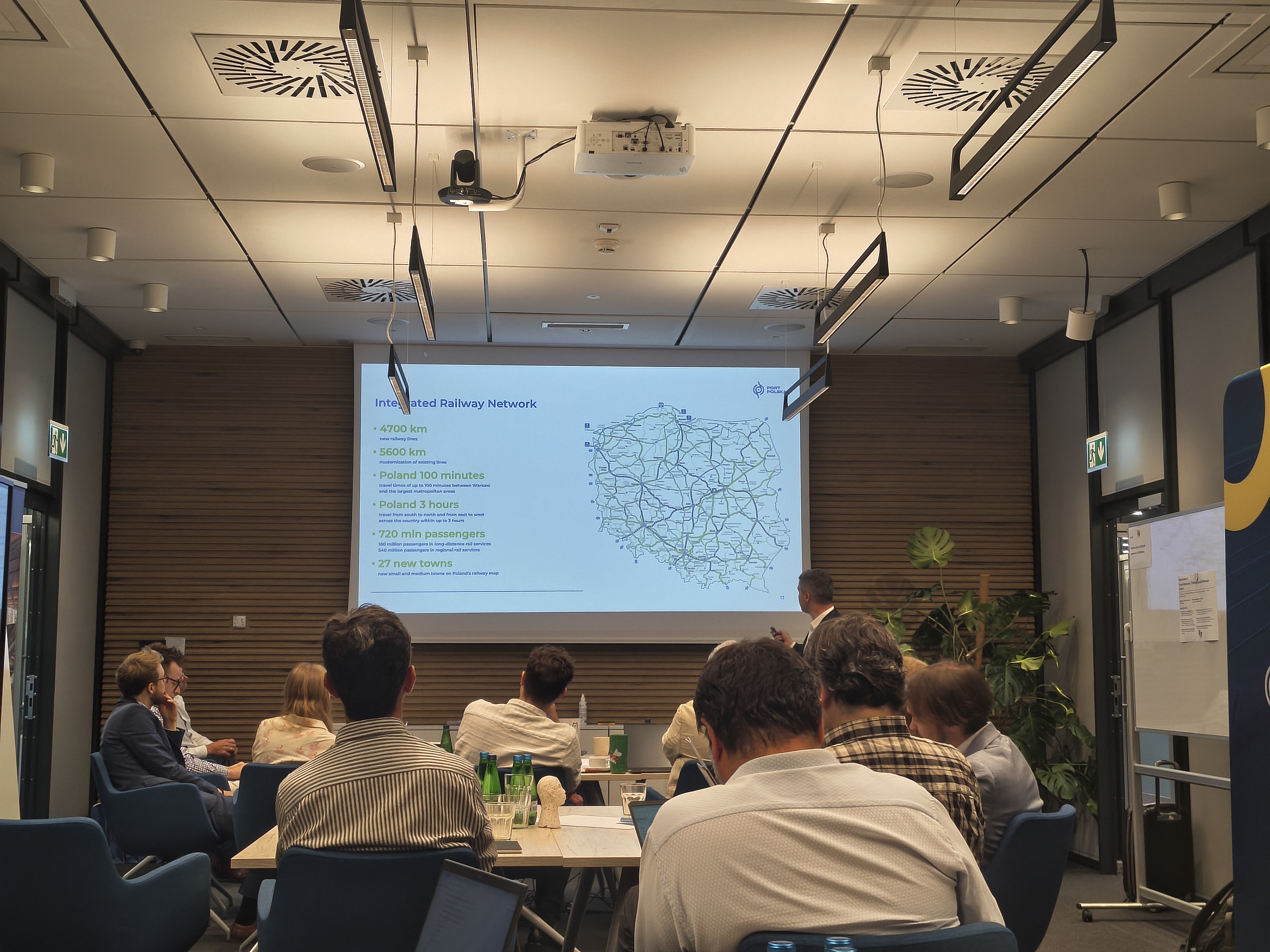
-
SUM Team at EWGT Conference
Last week, members of our SUM Team participated in the EWGT Conference, hosted at Cracow University of Technology in Kraków. The conference, excellently organized by Arek Drabicki and colleagues, brought together an international community of researchers working on transport, mobility, and traffic modelling. During the conference Rafal, Olha and Hanna presented a poster showcasing our latest work with SimFLEX. Building on our previous simulation framework, we are now using it not only to investigate the expected performance of Shared Mobility Systems, such as Kraków’s LajkBus, but also to explore how their optimal service areas can be determined. Our current approach combines Greedy Expansion with H3 hexagonal spatial indexing, providing a flexible way to identify and evaluate potential service areas based on the characteristics of the transport system and its users. We look forward to continuing this work - and to welcoming everyone to Kraków next year for the hEART 2027 Conference.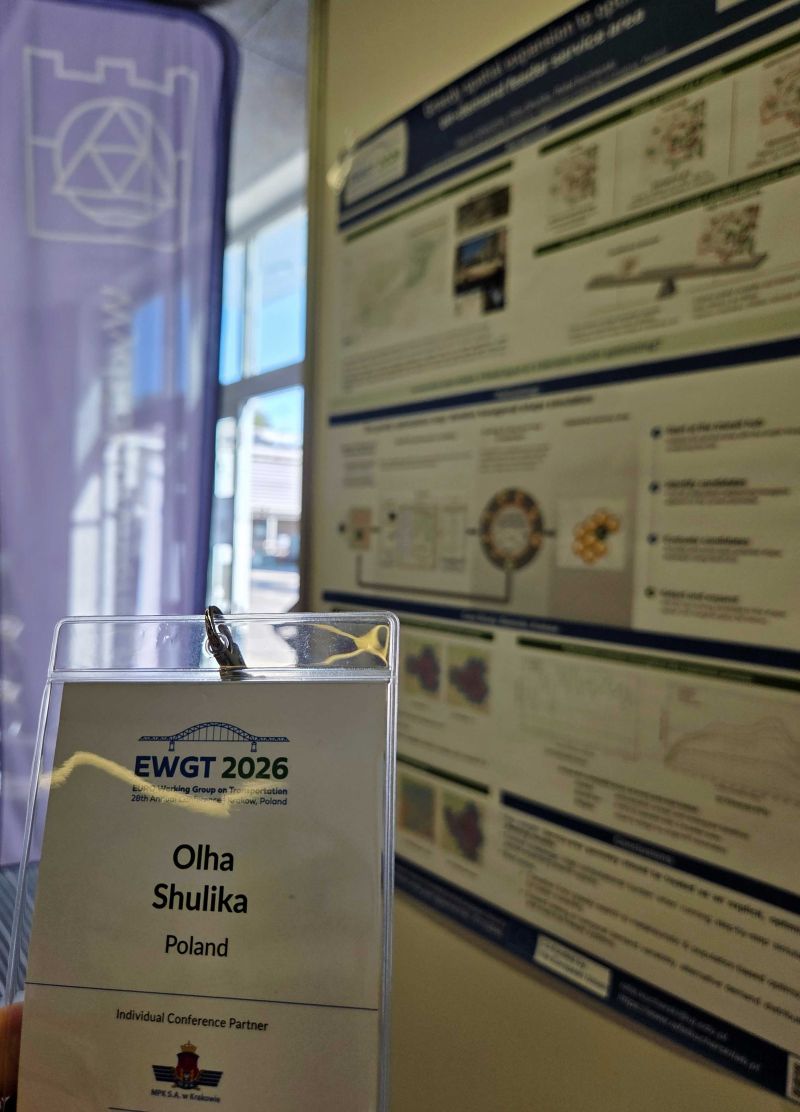
-
Our research showcased at ICML 2026 in Seoul
We are excited to share that our team presented four research posters at the International Conference on Machine Learning (ICML) 2026 in Seoul — one of the world’s leading conferences in artificial intelligence and machine learning. Our contributions focused on advancing multi-agent reinforcement learning, cooperative AI, and intelligent transportation systems, exploring how autonomous agents can learn, collaborate, and make better decisions in complex real-world environments. Represented by Anastasia Psarou and Onur Akman, our team had the opportunity to discuss our latest results with researchers from around the world, exchange ideas, and receive valuable feedback from the machine learning community. More about our papers here -
Two Weeks of Learning at MLSS NYC 2026
The second half of June was an intense and inspiring period for Onur. He attended MLSS NYC 2026 at Columbia University in New York. During the two-week summer school, he took part in lectures delivered by leading experts in machine learning, explored topics beyond his own research area, and exchanged ideas with early-career researchers from around the world. The experience brought new perspectives, valuable scientific connections, and fresh inspiration that will contribute to our ongoing ERC research. 🌍🧠